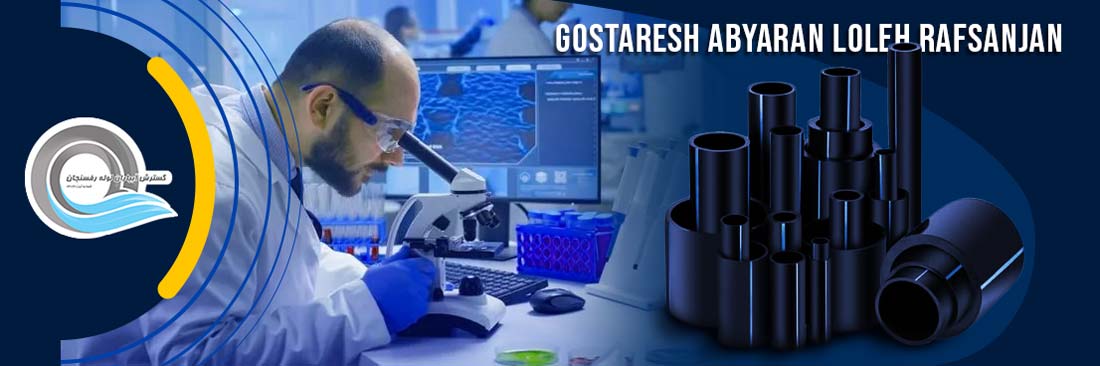
Rafsanjan Pipe Irrigation Expansion Company has modern and precise laboratories, equipped with the most reliable and up-to-date devices in the international arena, conducting tests on raw materials, pipes, fittings and valves in accordance with the latest standards developed by reputable national and international authorities, and providing accurate results. Rafsanjan Pipe Irrigation Expansion Laboratories have become a reference laboratory and partner of the Standards Department and the Agricultural Jihad Development and Mechanization Center, which, in addition to having an ISO/IEC 17025 certification for testing laboratories, provides laboratory services to the Standards Department and other organizations and factories.
Polyethylene pipe tests
Pipe Dimensional Measurement and Appearance Inspection (INSO 2412)
Polyethylene pipes must be free from any roughness (internal and surface) and deep pores, and minor dents can be ignored provided that they do not reduce the thickness to less than the standard limit.
Accurate determination of the pipe wall thickness using calibrated calipers at the cut section.
The outer diameter of the pipe is measured using graduated metal tapes (circometers) along a branch of the pipe and its average value is reported.
Determination of the amount of change in the roundness (bi-width) of the pipe using calibrated calipers.
Hydrostatic Pressure Test (ISIRI 12181)
The above test is performed to check the strength of the product against hydrostatic pressures. In this test, the pipe samples are immersed in a pool of water according to the pipe size and type of raw material in the following ways:
At 20°C for 100 hours
At 80°C for 165 hours
At 80°C for 1000 hours
They are placed under constant internal pressure. The appearance of any defects in the samples (bursting, swelling, local swelling, leakage, and hairline cracks) means that the product is rejected.